Solar Panel Buying Guide for South African Homes (2026)
Updated 27 August 2026
An inverter and battery keep the lights on during an outage, but they still need recharging from the grid between cycles — which means you're still fully exposed to rising Eskom tariffs. Solar panels are what actually reduce your dependence on the grid itself, charging your battery bank from sunlight instead. This guide covers what to look for before buying panels, without assuming you're starting from zero.
Panel wattage — what it means for you
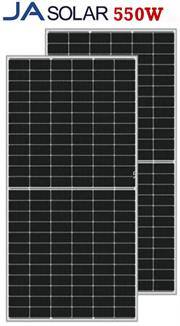
Panel wattage (commonly 400W-550W for a standard residential panel) is its rated output under ideal lab conditions, not what it produces every hour of every day. Real-world output depends on how many hours of usable sun your roof gets, the panel's angle and orientation, shading, and cloud cover — which is why sizing a system is about your household's daily energy usage (in kWh) and available roof space, not just "buy the highest wattage panel." A qualified installer can size this properly; this guide is about understanding the panel itself before you get that quote.
Monocrystalline vs. polycrystalline
Monocrystalline panels (made from a single silicon crystal, usually recognisable by their uniform black cells) are more efficient per square metre and perform better in partial shade or lower light — the standard choice for most South African roofs today, especially where roof space is limited. Polycrystalline panels (blue-tinted, visibly grainy cells) are typically cheaper but slightly less efficient and take up more space for the same output. Half-cell and bifacial panels (which can capture some reflected light on their rear side) are increasingly common variants of monocrystalline panels worth asking about if you're comparing quotes.
Mounting & cabling basics
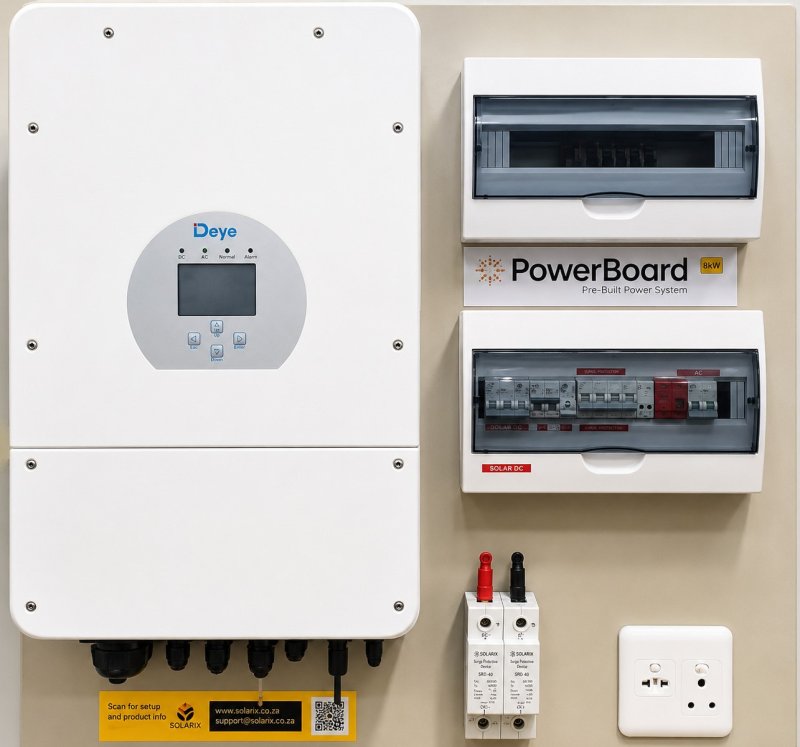
Panels need a mounting structure matched to your roof type — IBR/corrugated metal roofs, tiled roofs and flat roofs each use different bracket and rail systems, so this isn't a one-size-fits-all purchase. Beyond the panels themselves, a complete setup needs: mounting rails and clamps rated for the panel size, solar-rated DC cabling (thicker gauge than household wiring, UV-resistant), a DC surge protector, and battery connector cabling sized correctly for your inverter's voltage (commonly 12V, 24V or 48V systems). Getting the cable gauge wrong isn't just inefficient, it's a safety issue — this is one part of the system worth not cutting corners on.
How solar, inverter and battery fit together
Solar panels on their own don't power your home — they charge a battery bank through a charge controller (often built into a hybrid inverter), and the inverter converts that stored DC power into the AC power your household appliances use. If you haven't sized your inverter and battery yet, start with our inverter & UPS buying guide first — the panels are only as useful as the storage and inverter capacity behind them.